Chapter 08: Macro photography
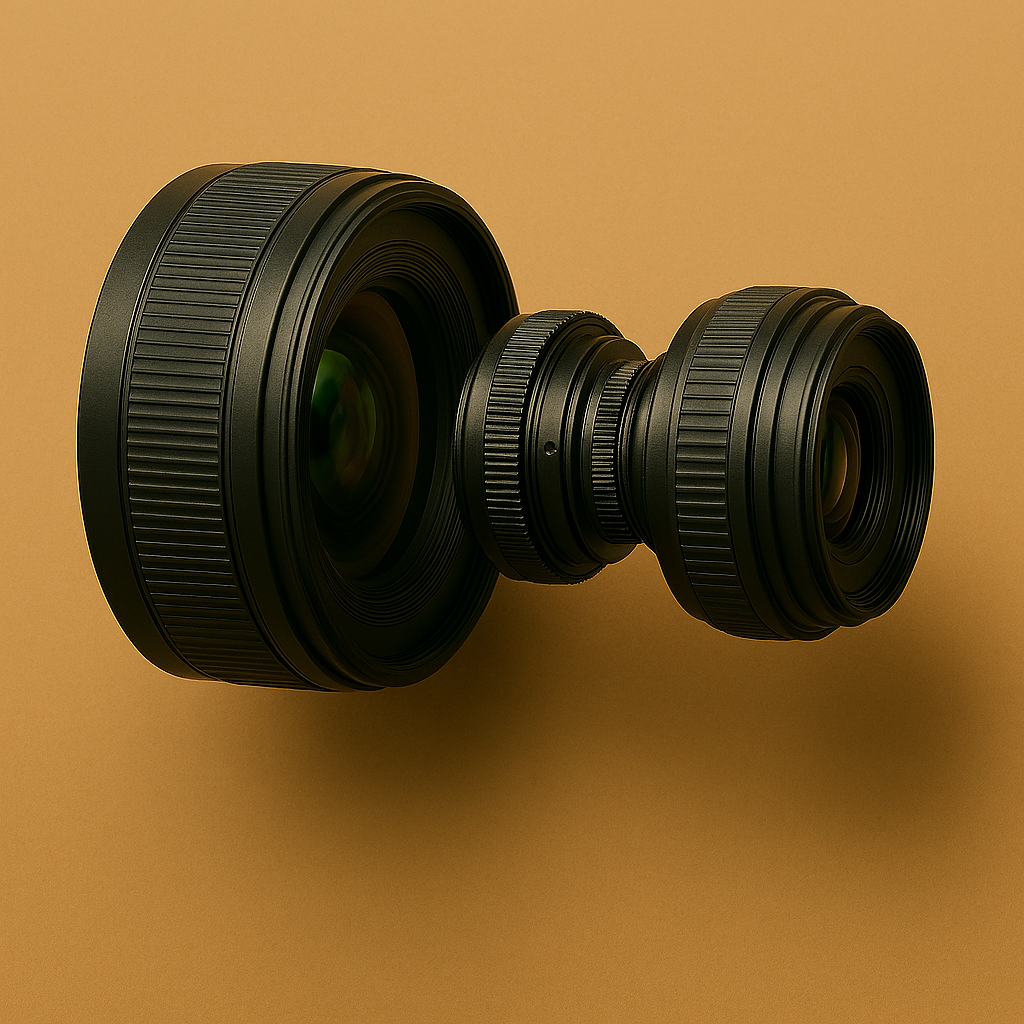
Reversing a lens exploits the fact that standard photographic lenses are optimized to project a large field of view onto a small sensor. When reversed, the optical design is effectively inverted: the lens now projects a very small subject area onto the sensor at high magnification. The lenses you mount together should have the same diameter.
Optical principes
A reversed wideangle lens (e.g., 28–50 mm) produces high magnification because its optical formula is designed to enlarge a small image circle.
Magnification ( M ) for a reversed lens is approximately when used on a bellows or extension system:
Technical characteristics
Working distance becomes extremely short (often 3–5 cm).
Aperture control is typically manual; electronic diaphragms remain closed unless locked.
Field curvature and chromatic aberration increase at extreme magnifications.
Dust exposure is a risk because the rear element faces outward.
Use cases
Extreme macro (2:1–5:1)
Static subjects
Controlled lighting environments