Chapter 01: Camera and sensor types
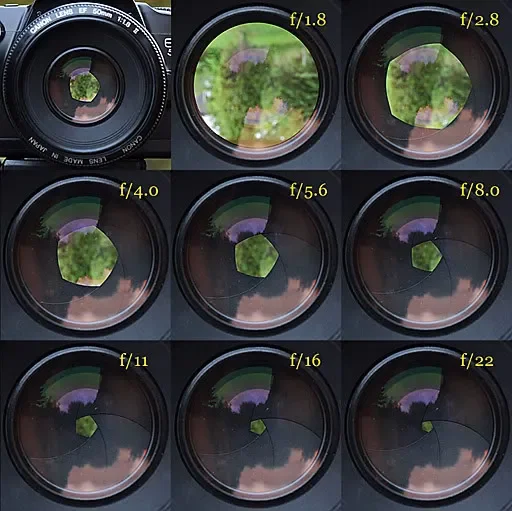
I have used the term “aperture” a few times already without giving it much of an explanation. It is an important concept to get the hang of. Aperture is the opening inside a lens that lets light pass through to the camera’s sensor. You can think of it as the lens’s “pupil”: it widens to let in more light and narrows to let in less light.
Aperture size is expressed as an f‑number, for example f/1.4m f/2.8, f/5.6, f/11 and f/16. A lower number means a larger opening. A higher number means a smaller opening. And how you use the f-number determines in many ways how your image is going to turn out. This was something hard to grasp when I was new to photography.
Aperture affects different aspects of your picture. Exposure time for a start. Large aperture (f/1.4–f/2.8) gives more light, which gives brighter image. Small aperture (f/8–f/16) gives less light and darker image. This also affects exposure time as well as depth of field. Large aperture (f/1.4–f/2.8) gives shallow depth of field which gives blurred background. In photograph this is called bokeh. Small aperture (f/8–f/11) is preferred for many photographers because it gives deep depth of field and this gives more of the scene in focus. Many lenses are sharpest around f/5.6–f/8. Very small apertures (f/16–f/22) can cause diffraction, reducing sharpness. Aperture is one of the three pillars of exposure (along with shutter speed and ISO), but it’s also a major creative tool. It controls portrait background blur, landscape sharpness and low‑light performance.
Bokeh refers to the quality of the out‑of‑focus areas on a photograph, not just how blurred they are, but how that blur looks. It comes from the Japanese word ボケ (boke), meaning “blur” or “haze.”
<sett inn bilder som viser bokeh>
You can compensate with a high f-number by using longer exposure time or a higher ISO, but this can come at a cost of poorer image quality. When you become better at photography you will weigh the pros and cons in this fast.